
To the Letter
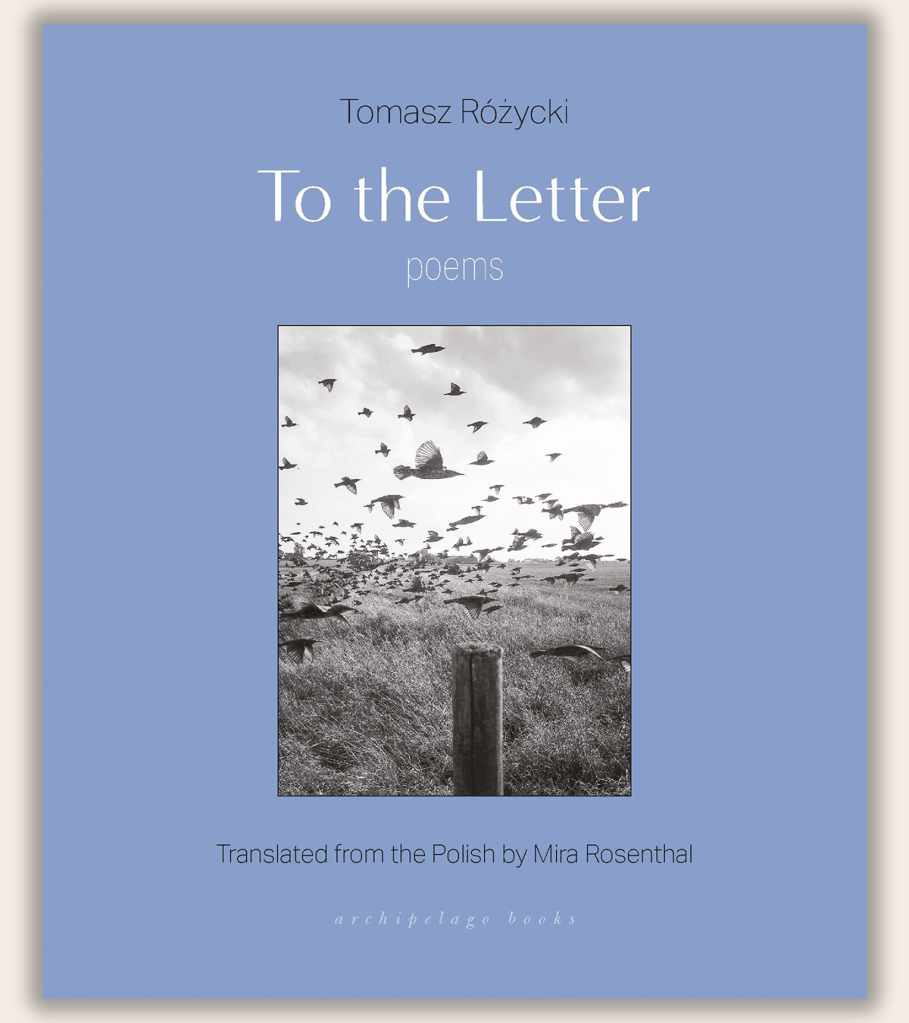
+ Order Now
Archipelago Books, 2024
LitHub, “7 New Poetry Collections to Read in December”
Reviewed in The New York Review of Books
Reviewed on Harriet Books (the blog of the Poetry Foundation)
Reviewed in Words Without Borders
Tomasz Różycki’s To the Letter follows Lieutenant Anielewicz on the hunt for any clues that might lead 21st-century human beings out of a sense of despair. With authoritarianism rising across Eastern Europe, the Lieutenant longs for a secret hero. At first, he suspects some hidden mechanism afoot: fruit tutors him in the ways of color, he drifts out to sea to study the grammar of tides, or he gazes at the sun as it thrums away like a timepiece. In one poem, he admits “this is the story of my confusion,” and in the next the Lieutenant is back on the trail. “This lunacy needs a full investigation,” he jibes. He wants to get to the bottom of it all, but he’s often bewitched by letters and the trickery of language. Diacritics on Polish words form a “flock of sooty flecks, clinging to letters” and Lieutenant Anielewicz studies the tails, accents, and strokes that twist this script. While the Lieutenant can’t write a coherent code to solve life’s mysteries or to fill the absence of a country rent by war, his search for patterns throughout art, philosophy, and literature lead not to despair but to an affirmation of the importance of human love. Różycki collects moments of illumination – a cat dashing out of a window and “feral sun” streaking in, a body planting itself in the ground like rhubarb and flowering. He collects and collects, opens a crack, and clutches a shrapnel of epiphany.
Awards
2025 Found In Translation Award Winner
2025 PEN Award for Poetry in Translation Winner
2025 AATSEEL Award for Best Literary/Scholarly Translation into English Winner
2025 Northern California Book Award Finalist
2024 Griffin Poetry Prize Longlist
Excerpts
“A Glass”—The Hudson Review
“Shadow” and “Translator’s Note on ‘Shadow’”—Poetry Magazine
“Clay” and “An Unexpected Turn of Events” by Tomasz Różycki—New York Review of Books
“Phantom”—Guernica
“Third Planet”—The Kenyon Review
“This Era”—Poetry Daily
Three Poems, “Europe and NATO Since Ukraine” Special Feature—Europe Now
Online Exclusive: Three Poems by Tomasz Różycki—Two Lines
“Backpack”—Zócalo Public Square
“Essential Features” and “There Is No Answer”—Tupelo Quarterly
“A Room” and “Wild Strawberries”—Plume
Four Poems by Tomasz Różycki—Asymptote
“Wind”—Cagibi
“What of Him?”—The Continental Literary Magazine
Interviews
Literary MagNet—Poets & Writers Magazine
The Music of Other Tongues: On Translating Rhyme and Rhythm in Poetry—LitHub
A Conversation with Tomasz Różycki—Music & Literature
Praise
“A love letter to the language, the one remnant of history that a poet, calling on his forebears, need not be ashamed of. Rosenthal deserves special praise for rendering Różycki’s wordplay, musical density, and metonymic dazzle into powerful English.”—Angie Mlinko, The New York Review of Books
“The conceit of an elusive surrogate works against the very tangible despair of war, exile, and displacement, but it also hints at a delusional grandeur more common in fiction than in poetry. Where poetry usually stops at anguish, Różycki goes the whole length to realize the fullness of a proxy conjured by loss, the stranger who lives on in the mind.”—Janani Ambikapathy, Harriet Books (the blog of the Poetry Foundation)
“In this philosophical collection that explores doubt—regarding language, God, and the prospect of repeating history—many poems address an unreachable ‘you’ who could be a lover, a deity, or a ghost of someone long dead. Rosenthal’s translation draws out these poems’ shades of melancholy and whimsy, along with the slant and irregular rhymes that contribute to their uncanny humor. Różycki’s verse teems with sensuous, imaginatively rendered details: ‘that half-drunk cup of tea, the mirror / filled up with want, the strand of hair curling toward / the drain like the Silk Road through the Karakum / known as Tartary, the wall that defends the void.’”—The New Yorker
“The poems are intimate and wry, philosophically complex, and charged with metaphors for absence and language itself.”— Dana Isokawa, Poets & Writers Magazine
“A serious yet playful book, creatively experimental while urgently addressing the local and global history and the prescient now. Mira Rosenthal’s dexterity and craft as a poet herself are made evident in her intricately wrought translations from Rozycki’s complex and nuanced Polish… This translation of To The Letter exemplifies Rozycki’s masterful technique—poetry is the conjunction of technique and an aesthetic vision—as one of his country’s leading poets, while at the same time establishing Rosenthal as one of our most skillful translators.”—from the Judges’ Citation, PEN Award for Poetry in Translation
“It is always exciting to watch how a translator gradually penetrates a poet’s work. Mira Rosenthal is an experienced translator of Tomasz Różycki’s work. Thanks to her loyal and beautiful translation of To the Letter, she has managed to achieve an enviable goal, both enabling readers to get to know the poet’s voice, while at the same time creating a work that has gained an independent voice in English.”—Anna Zaranko
“In her extraordinary translation, Mira Rosenthal enters the rich world of Tomasz Różycki’s poems and tackles the considerable formal challenges with deep dedication, intelligence, and grace. The poet is very lucky to have found such a translator, and English-speaking readers are very lucky to have gained access to a contemporary poetic project of such stature and beauty.”—Alissa Valles
“The poems in To the Letter move from casual and chatty to devastating with a quick shift in line, associative thoughts leaping out like small flames… Mira Rosenthal’s outstanding translations [are] subtle, musical, and swift while never slipping into stranslation-ese. Różycki has found an eminently worthly translator in her hands.”—from the judges’ citation, Northern California Book Award
“The erasure of such a large part of Poland’s Jewish population during WWII and the impact that that trauma had on the present operates like a tidal undercurrent in this text… What sorrows have we buried in our backyard and forgotten? What evils do we believe couldn’t possibly happen again? Rosenthal’s expert translation helps us plant these atrocities in our own gardens, so that when we look up from reading this book, we see the phenomenon happening where we live.”—Iris Dunkle, Words Without Borders
“An existentially grounded, metaphysically nimble soul, intrinsically defying the authoritarian project that empowers itself by convincing people that they are drastically oversimplified, reified versions of themselves… Rosenthal’s English iterations fully relay the poems’ accessibility, music, and humor—as well as the ways they integrate into surprising valences with creativity, love, and interbeing.”—Michael Collins, Asymptote
“Across the ninety-nine poems of Polish poet Tomasz Różycki’s To The Letter, presides a calling out to absence, often in the form of this “you” whether in loss—cultural, global, personal—or self-examination . . . This collection has, perhaps, added resonance landing in 2023: “You—out there where the future pushes through like a worm from an apple, only the hole is in heaven and so enormous we’ll all fall in, along with tenements, convenience stores, our entire state—let’s say it’s nowhere—” A notable contribution to Polish poetry available in English–and a vital living voice, no less.”—Rebecca Morgan Frank, LitHub
“Różycki’s poems contain it all: high culture and the margins of society, seriousness, irony and self-mockery, scholarly allusions and the con- creteness of everyday life in difficult times. This is the great lesson of the Polish tradition: to create poetry out of the material of suffering.”—Wisława Szymborska Prize Jury
“‘We live in feral times,” the poet says, asking us ‘what shape this era will carve / in flesh.’ In Mira Rosenthal’s exacting, beautiful translations, Tomasz Różycki’s work gives us a moment of honest assessment, answering hard questions without patronizing, with lyric precision. One of Poland’s best living poets, he is writing at the height of his powers. Which, for me, means: there is mystery in his work that feels trustworthy—‘we will dig ourselves out of our private muck / of subtext, shed the weight,’ he says, ‘and fly off, empty, for the nearest lightbulb.’ It is amongst the quotidian that he seeks to be saved, his is a vision in which, despite all the tragedy of this new century, the thrust that sings ‘at two a.m. outside / our window in the parking lot has saved / the day, the month.’ If that is to be our new metaphysics, count me in.”—Ilya Kaminsky
“This poetry is serious, a private response to the historic moment… In the chain of poetic generations, Tomasz Różycki stands apart.”—Adam Zagajewski
“Tomasz Różycki’s idiosyncratic rapprochement with tradition is an attempt to make peace with his losses, even as they mount.”—Times Literary Supplement
“The world that Tomasz Różycki shows us is neither sentimental nor straightforward. It is a world of global reality, a postmodern mix of arrangements and styles in which the desire for meaning, even tempo- rarily anchored, seems to be the dream of a daydreamer, a naïve seeker of something permanent from newspaper gossip, collective hysteria, and pop cultural pulp, in which—like it or not—we are sunk up to our ears.”—Paweł Huelle
 Mira Rosenthal