
Mer de Glace
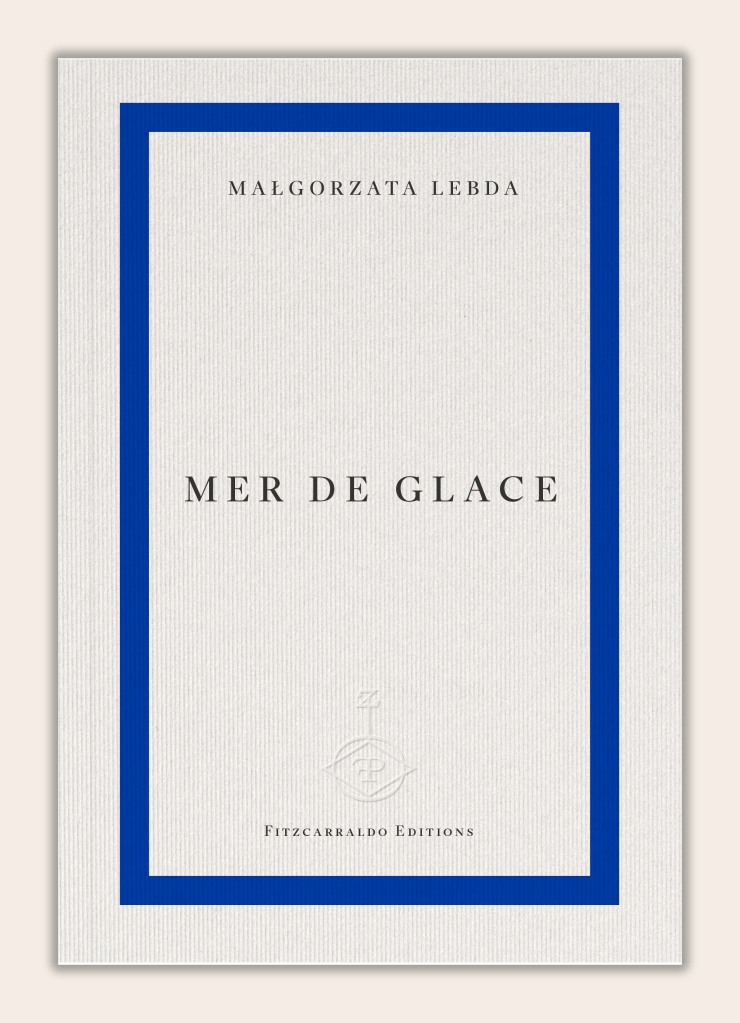
Fitzcarraldo Editions, 2026
WWB’s Most Anticipated Books of 2026
Reviewed at Words Without Borders
In 2021, Małgorzata Lebda ran the entire length of the longest river in Poland, the Vistula, from its source in the Beskid Mountains to its mouth at the Baltic Sea. She set out to run as a poet, not as an athlete, to use the rhythms of her own body as a means of understanding and connecting to the rhythms of the river’s body of water, under threat of environmental ruin. Mer de Glace, which was written during training for her run and went on to win the prestigious Wisława Szymborska Award, is the prelude to her remarkable journey. A meditation on the porosity, reactivity and receptivity of both the body and the natural world, the collection reveals their interdependence.
Awards
2026 PEN Heaney Prize Finalist
2024 Jan Michalski Foundation Residency
2022 Wisława Szymborska Award (for Polish edition)
Excerpts
“On ‘Canopy’ and Translating Małgorzata Lebda”—Poetry Society of America
“Mira Rosenthal on Translating Małgorzata Lebda’s ‘Seasonal Plots (III)’”—Poetry Daily
“Literature & Democracy” feature on the work of Małgorzata Lebda—New England Review
Three Poems—The Kenyon Review
Book of the Month—Caught by the River
“Seasonal Plots (V)”—Wet Grain
Translator’s Intro and Three Poems by Małgorzata Lebda—Poetry Northwest
Five Poems by Małgorzata Lebda—Arkansas International
Interviews
“Writing As the Art of Participation”—PN Review
Praise
“This is ecopoetry at its most profound and informal, challenging and pleasurable.”—Fiona Sampson, The Guardian
“Małgorzata Lebda’s poetry never ceases to amaze the reader. Even a chance encounter with it imperceptibly creates an everlasting connection. As eternal as the bond between the frozen sea and the forest.”—Olga Tokarczuk
“Each poem uses consonance, assonance, and alliteration to astounding effect, without ever feeling heavy-handed, as Lebda invites us to appreciate the interconnectedness of otherwise disparate moments, acts, and objects without compromising their singularity… By the light of Rosenthal’s dazzling translation, Lebda’s ecopoetic trek finds a true home in English.”—Edith Adams, Words Without Borders
“‘Movement against loss. Summer has its autumnal thoughts. / Bets made with your own body.’ So begins Malgorzata Lebda’s poem ‘Trigger Points’ in Mira Rosenthal’s translation of Mer de Glace. I keep thinking of Rosenthal’s translation notes for the collection, in which she begins with a long list of words and phrases that move from ‘Bright’ and ‘Brilliant’ through ‘Obvious’ to ‘Of Course!’ and ‘Sure Thing!’ Words, Rosenthal tells us, ‘I hoped would come in handy whenever I came across the word ‘jasne’, for which all the above could be possible translations, depending on context.’ She continues, ‘You see, the way Lebda uses it, the neuter adjective takes on the feel of an abstract noun that imbues the poems with a kind of life force related to brightness, radiance, clarity, and luminosity, carrying with it a sense of attentiveness and care.’ How fitting, such granular attention and such vastness as we move past autumn towards the longest night of the year… Compelling, sparse, these poems stay grounded while tracking the mind’s wanderings along the river.”—Rebecca Morgan Frank, LitHub
Lebda grounds her stunning work in the disciplines of rural life, nature’s abiding marvels—moonlight, rose thorns, hooting owls, the looming crowns of trees at night—and the eye-raising ways isolation leaves its mark.—Matt Sutherland, Foreword Reviews
“Małgorzata Lebda’s startling Mer de Glace—so necessary for our ecological moment—connects the body to landscapes, reviving that ancient intimacy through language fertile as black soil, bright as sun on glacial ice, and urgent as a dog’s moonlit howl.”—Michael Downs, author of The Greatest Show: Stories
“‘It’s the job of the senses to turn into words,’ writes Małgorzata Lebda in “Geography”. Her poems operate like a dog’s sense of smell in darkness: they venture forth with a clarity heightened by a tender knowledge of the embodied quality of all things—human, animal, celestial, natural, unnatural and linguistic. From a culture with an unparalleled tradition of poetry, Lebda is another truly fine poet from Poland. Her poetic vision is so singular and her style so distinctive we already have in usage the term ‘Lebda-esque.’”—Alice Lyons, author of Oona
“What does a poet see when she runs along an entire river? In Mer de Glace, Małgorzata Lebda presents poems of extraordinary attentiveness to sensory experience, finding in tiny details such as the closing of an eyelid or the flesh of a greengage plum the same life force that courses beneath the glacier of the book’s title. Dense and luminous, these poetic missives from a body in motion amount to a radical act of presence that runs along the nerve between the intimate and the immense—rooted in landscape, language, and the rhythm of one foot placed in front of another.”—Scotia Gilroy, writer and translator

