
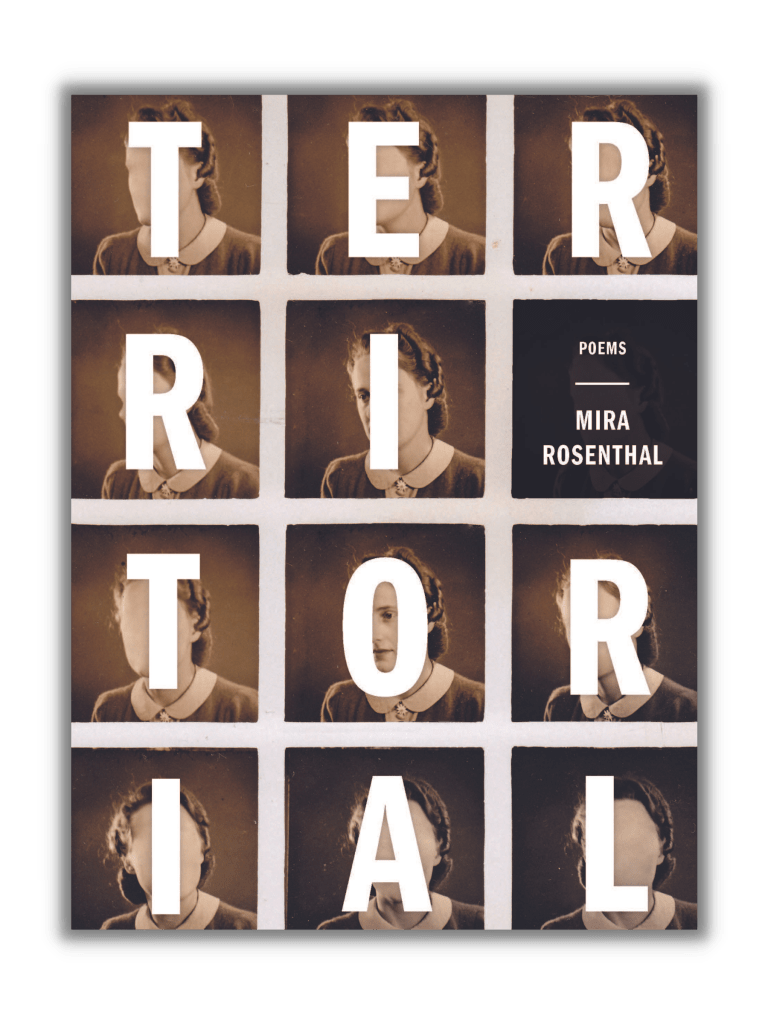
Territorial
University of Pittsburgh Press, 2022
Territorial explores the bargains that women make to stay safe from violence. Set in a landscape of looming ecological ruin, the poems bear witness to the effects of drought on the California chaparral region and delve into difficult personal terrain to reveal patterns of abuse we inflict on the earth and each other. How can we emerge from a devastated landscape into a sense of healing and repair? Using the characteristics of violence—repetition and escalation—the collection connects subjects that range from the dawn of recorded sound to the mapping of myths onto constellations, the ecosystem of a leach pond, and the photographs of Alfred Stieglitz. In tracing the ways narratives of predation imprint onto the body, memory, environment, and future generations, Territorial finds resilience in the powers of language to reshape experience.

Awards
2023 Eric Hoffer Award Honorable Mention
2022 Foreword INDIES Book of the Year Finalist
Praise for Territorial
“Every poem in Territorial is stunning—each spun fiercely with beauty as well as tremors of perpetual threat and violence against the female body. Mira ‘in Russian / it turns out means World, / so there are countless maps / of me & my confessions / in a language I can’t read.’ Indeed, every poem in Territorial is a ‘Mira’—each a mirror-map that precisely locates precarious bodies across terrains of trauma.” —Don Mee Choi, author of DMZ Colony
“Mira Rosenthal’s Territorial offers an alchemical encounter with language that is in itself a form of hope despite all manner of endangerment… In poem after beautiful poem, Rosenthal returns repeatedly to the ways in which exploration of the territories we inherit and inhabit is perhaps the only salvific recourse… The speaker stays with her story, her fear, her suspicion, and pushes into it, exploring and then foregoing old, knee-jerk images in favor of a new way of seeing and surveying the world.”—Lisa Russ Spaar, The Adroit Journal
“Territorial scrutinizes patterns of dominance that leave an indelible imprint on the human psyche and, by extension, also on the earth… responding not just with anger and outrage, but with a leaping into life (even knowing the risks).”—Meg Schoerke, The Hudson Review
“Mira Rosenthal maps domains of danger in her stunning second collection, Territorial. ‘There’s tinder underneath our days,’ she writes, bearing witness to drought-ridden California, the female body in peril, the earth in crisis, the constant threat of violence balanced with sensual joy. These poems explore risk and womanhood, what it means to live among potential predators (mountain lions, humans), to navigate territories both urban and wild… The speaker in Territorial becomes a goddess, a gardener, a fury in the kitchen slicing onions: ‘I admit at last/ there’s a river of rage below the surface,/ hidden, though I didn’t mean to hide it.’ Renewal lies in the self’s dynamic energy, a wild internal force driven to create.”—Diana Whitney, Electric Lit
“Rosenthal’s virtuosity as a poet is on display… She does not undercut or retreat from the project of the book: articulating the atmosphere of violence that surrounds women. Nonetheless, she acknowledges that the world is wide. Even while asserting the ways we have been scarred and marked, Rosenthal suggests that there is room to move to unclaimed space, to see and to hold something more: gentleness.”—Emily Pérez, Rhino Reviews
“Upon reading this book a song kept coming to mind, and I found myself humming ‘How I got over?, how I got over?/you know my soul look back and wonder/how I made it over?’ This question Mahalia Jackson asks is also the question central to Territorial: Rosenthal writes, I am trying to think/ back to how she finds her way through… This author wonders how a woman can survive in the midst of so much desiccation? How to recognize connection when being uprooted or rendered. This is the kind of work a reader longs for. A book we believe. Sensual, frightening, richly wrought and balanced, this book holds no truisms, no aphorisms. The nuances of person and place are expertly exposed. There is tenderness, yes, but it roots alongside implicit and complicit violence. All are connected but all won’t be saved. Territorial, takes us by the hand the way a mother in this book may take (tightly) a daughter’s hand because she means for us to take this journey with her, to show us the hard stakes of becoming, of moving out of our own small gardens and into the larger world. As is the case with the best translators, the intersecting worlds she maps fling us across the globe and back, as well as into both the devastating slippage of personal memory and the gendered pressure of collective mythology. Rosenthal notes that any such mapping is some kind of outline in the dust— as if vastness can be tamed with a map…. She knows it can’t. But the trying is a successful attempt at being, and not being alone. This is a poet you will return to.”—Vievee Francis, author of The Shared World
“Nothing in these poems is wasted, not a single word or syllable or sound. In poem after poem throughout Territorial, the writing is tight and musical and concrete, and the substance is profound.”—Lynn Domina, author of Corporal Works
“A work of narrative beauty and lyrical depth, Mira Rosenthal’s Territorial mines through a lush and sensual life for deep emotion and ardent language. Through the examination of the violence and the delight of the quotidian, the poet brings forth an unnerving reckoning, exposing the anxieties and complexities of her generation. Swept away by searching imagination, Rosenthal stays grounded in the body. Amid her body’s shadows she finds clarity and peace.”—Valzhyna Mort, author of Music for the Dead and Resurrected
“Territorial begins with origins—of an interstate system, of sexual threat inherited from myth, of “some nocturnal female sense” a daughter learns on watch for cougars in a state of drought. Mira Rosenthal traces how these paths are cut and circumscribed by human violence, capitalism, environmental exploitation. It is deeply refreshing to see these forces intertwined in poem after poem, to see a book that is as sensual as it is intelligent, as critical of the self as it is of the larger world, as microscopically precise as it is wildly transgressive. Prepare to be unsettled and transfixed by this extraordinary collection.”—Corey Van Landingham, author of Love Letter to Who Owns the Heavens
 Mira Rosenthal